AP Composition and Language Reference Guide
Analysis
Compare and Contrast: Summary and
This will become your life
AP Test
Intimidation
Nine Point Scoring Guide
Preparation for (see Power Writes, Finals)
Appeals
Ethos
Logos
Pathos
Never actually name these in a formal rhetorical analysis
Aristotle
Attitude
Cardona's Reality Check
Optimism is key
You WILL fail sometimes
BLA (see Procrastination)
Genius Group
Freakonomics
Outliers
Bitzer
Exigence
OMG what?!
Never actually thoroughly annotate this, otherwise it'll take 45 minutes per page
The Rhetorical Situation
Blogs
Analysis Project
Top-Visited Tabs
Yeah, Write
#Tallgirlproblems
Cardona (see Sarcasm)
Cutest puppy award goes to
Fellow Toms wearer
She really DOES care about us
Confidence
Don't believe your Honors Communications teacher's praise
Shattered and Slowly rebuilt
Close Reading Journals
I'm just going to pretend I know that word so I don't have to write it down...
No appreciation for all of the work that went into them
Collaboration
All Hail the Cardona, Facebook
Google Docs
Emoticons
Degrading
Don't you dare ;) at me
Sarc Mark, anyone?
Everything's an Argument
Don't try to question it
Unless its a quiz question on the "On Being a Cripple" quiz
Facebook (see Collaboration)
Finals
Free Writes
Encouraged Journaling time
Emotions
Practice makes perfect
First Drafts
Shitty
Grade Point Average
Meet Real Life...
Hanson, Max
Cardona v. Hanson, who will win this time?
SMH
Humor (see Satire)
Pathos
Parody
Who knew there was more to it than simply entertaining?
Onomatopoeia
Orwell
Fresh Language (don't you dare write anything you've heard before)
Parallelism
Do this, do that, and make sure to do the other thing
Power Writing
Battle for the Fleur De Lis Stamp
Sprint Practice
Time Management Skills
Projects Galore
Mixtape
Speech Analysis
Blog
Visual Essay
Procrastination Nation (see BLA, Finals)
Picture Fridays
Block one is looking fine
Bonding
Cheesy smiles
Quizzes
C= Celebration
They'll come back to haunt you
Revision
Also known as "re-write a brand new piece"
BFR
Revise and Repeat, the life of
Rhetoric
The foundation of Composition is
Everywhere
Rhetorical Analysis
Struggles
"But Why?"
Readings
My Printer's #1 Enemy
Orwell
50 Essays
Satire (see Cardona, Johnathan Swift)
Success
Learning how to work for it
Summative
The Devil's grading system
NNNOOOOOOOOOO!!
Get prioritizing
Swift, Johnathan (see Satire)
Om Nom Nom
Read Closely
Toulmin
Claim, Reason, Warrant
Wait, what's a warrant?
Visuals
Animoto Works wonders
Make an Argument
The media isn't always truthful...
Voice
If I can't imagine you reading it to me, its not good
Unique
What Not to Do (see Procrastination Nation, Emoticons)
Writing
How To
Joy of
Practice, practice, practice. And then practice some more.
Yay!
Typical class reaction on essay grading day
ZzzZZZzzZZZz (see Onomatopoeia)
Do the readings after school or else
Sunday, January 22, 2012

Monday, January 16, 2012
Pinterest #everydayblessings
Like every other student out there, I have saved a majority of my homework for today. Hence, I am sitting in a coffee shop with my laptop on and headphones in. I have SO MUCH to do, and I would be dying if it weren't for Pinterest. Its my reward for finishing something, and since its a site filled with pretty much everything under the sun it actually is a reward. Don't believe me? I'll prove it to you.
 |
| Spring Break To Do list. |
 |
| Wedding: Toast with old fashioned Coke bottles. |
 |
| How awesome would this desk be? |
 |
| Want. |
 |
| Wall Color + Books + Hidden library= coolest room EVER. |
 |
| tis true. |
 |
| Whoever created this-- props to them for saying what everyone thinks. |
 |
| at this point in time I think this cat is better at yoga than I am. Sad? yes. |
Saturday, January 14, 2012
Outliers #graded

So hence, it is the end of BLA, the day I hath dreadeth for now thy life is dreary.
If you want to read a book with diction like that (and a highly negative tone as well) then "Outliers" isn't for you. For the rest of you out there, don't let the topic and argumentative nature of the book scare you off. Gladwell does an excellent job writing to a broad, public audience with his use of simple diction and explanation, and both of these things help to educate the audience on his argument that is clearly supported throughout the book.
Gladwell argues that success is due to opportunities an individual has. Here's the catch: opportunities can span many different topics, including work ethic and experience, cultural background, and the pure luck behind the time of birth. These opportunities all work together to define a who a person is and who he is going to be, and, at times, a concentration on one opportunity can lead to a decline of another (such education and training that helps a Japanese pilot overcome his traditional values of respect of elders, allowing him to communicate more effectively at dire times in the cockpit). Once information backing his argument is given, Gladwell chooses to end "Outliers" with a proposal for the readers not to settle for the world we have, but change it by giving everyone, not just rare, "outlying," individuals the opportunities needed for success. Gladwell's positive faith in us to give the world more opportunities to success only helps to enforce his optimism on the topic of success and an individual's capability of achieving it.
Exposing his argument through chapters that each center around a different, but real example of "outliers" in real life, the reader finds much explanation. This explanation, while being through, can become repetitive and seemingly unnecessary after a while, but I found that the chapters have hidden gems of knowledge contained in one or two sentences. It is these little snippets of the chapters that made this read worth it to me, they were so true and inspiring (especially after reading a whole story of success that they work to summarize). My favorite of these gems is:
" Hard work is a prison sentence only if it does not have meaning. Once it does, it becomes the kind of thing that makes you want to grab your wife around the waist and dance a jig."
Go grab a book and discover what Gladwell has to teach you, I highly recommend it.
Monday, January 9, 2012
Blargh #sickness
I have come to the conclusion that waking up with a cold is pretty weird. I mean, usually you have some sniffle warnings or something, and its not just BAM! sickness. Phew. Good thing I didn't wake up with a cold.
I woke up this morning with a
full
blown
sinus
infection.
GAAAH. That is what I would call straight up weird. No wait, abnormal. Yeah, that word fits it more. Who does that? Why does my body hate me? (yes, that is dramatic but you would be thinking that too if it felt like a giant TRUCK was muscling its way through your face!)
Okay so I guess you could say I'm super used to it. Ever since I got kicked in the nose at practice in 2009 my right sinuses haven't been functioning, er, draining properly. Before that kick I had never had a sinus infection (what a heavenly, healthy little angelic child) but after that... oh boy. Since then I have had annual sinus infections, occurring from November to June, become immune to the Z-Pac that the doctors all prescribe as treatment, and the Netti Pot has become my best friend. But experience doesn't mean I'm used to the pain. Ugh, its still terrible.
Anyway. I suppose I should go drift to sleep to the wonderfully obnoxious buzzing of the nasty little humidifier that has found its way into my room. After taking some Sudafed. Maybe that'll help a bit.
Friday, January 6, 2012
Note to Self #graded
Dear 6th grade Ruth,
First things first, do not touch your hair one more time! You just touched it, didn't you? Well let me tell you something, your curly hair is beautiful, whether you think so or not. Yeah, its cray cray most of the times, and sometimes it looks like dreads, but you gotta just suck it up. Its gonna frizz, its gonna poof, and its never ever EVER going to look good on picture day (you and me both have senior pictures to worry about, chica), but you're gonna see those girls trying to curl their hair like yours and it'll never look the same. You have it all, naturally, so live it up. Same thing goes for your height. What are you now, like 5' 10"? and all of the guys must be about 5' 1". Yikes. Alright, they'll eventually hit puberty and shoot up (well most of them), and don't worry, the tallest guys are usually the cutest. Until then, stop trying to wear A&F and Hollister clothes. No matter how hard you try they aren't going to magically become long enough. Go to the Buckle instead. So yeah, start loving yourself. Life's going to be a lot more enjoyable if you do.
A quick side note, on top of loving yourself you should also love life. Here's a handy little tidbit: grades DON'T count in middle school. Yeah, its really important to develop good habits and you should always try your hardest (it'll pay off when you actually know how to do stuff in high school when everything counts), but you don't need to cry your eyes out over a C- on a 5 point quiz. Stop stressing and also, savor your sleep.
Speaking of sleep, which sounds fantastic, I'm off to catch some ZZzzZZzs,
See ya, wouldn't wanna be ya! (oh wait...just kidding!)
loveee, Ruthie
p.s. Regardless to what you think, the art room in Central ISN'T near the gym. Remember that for the first day of school, it'll save you about 20 minutes of walking (:
First things first, do not touch your hair one more time! You just touched it, didn't you? Well let me tell you something, your curly hair is beautiful, whether you think so or not. Yeah, its cray cray most of the times, and sometimes it looks like dreads, but you gotta just suck it up. Its gonna frizz, its gonna poof, and its never ever EVER going to look good on picture day (you and me both have senior pictures to worry about, chica), but you're gonna see those girls trying to curl their hair like yours and it'll never look the same. You have it all, naturally, so live it up. Same thing goes for your height. What are you now, like 5' 10"? and all of the guys must be about 5' 1". Yikes. Alright, they'll eventually hit puberty and shoot up (well most of them), and don't worry, the tallest guys are usually the cutest. Until then, stop trying to wear A&F and Hollister clothes. No matter how hard you try they aren't going to magically become long enough. Go to the Buckle instead. So yeah, start loving yourself. Life's going to be a lot more enjoyable if you do.
A quick side note, on top of loving yourself you should also love life. Here's a handy little tidbit: grades DON'T count in middle school. Yeah, its really important to develop good habits and you should always try your hardest (it'll pay off when you actually know how to do stuff in high school when everything counts), but you don't need to cry your eyes out over a C- on a 5 point quiz. Stop stressing and also, savor your sleep.
Speaking of sleep, which sounds fantastic, I'm off to catch some ZZzzZZzs,
See ya, wouldn't wanna be ya! (oh wait...just kidding!)
loveee, Ruthie
p.s. Regardless to what you think, the art room in Central ISN'T near the gym. Remember that for the first day of school, it'll save you about 20 minutes of walking (:
Tuesday, January 3, 2012
Watch this #graded
Here's my visual essay. Whats that? You want to know more about it? Wonderful, feast your eyes.
** WARNING: contains some mildly disturbing content.
Part 1: Structure of Argument
The
images chosen for this visual were based on the claim that factory farming methods
used to produce meat are cruel. This claim, supported by the images used in the
visual, rests upon the warrant that the audience cares about the ethical
treatment of animals in general, and views the humane treatment of animals as
being more important than economic benefits of mass meat production. It also
lies on the assumption that the audience is exposed to purchasing opportunities
in restaurants and supermarkets that sell meat that has been produced through
factory farm methods. This visual is intended to educate any and all consumers
of food on the issues with factory farming because it is a process that happens
“behind the scenes” and many are not aware of the conditions their food had
been raised in. Consumers are targeted because they have the choice of buying
meat that was produced using mass farming methods. I am especially targets
teenagers because they are the next generation of consumers and have the power
to set precedents through choosing not to support factory farming.
Part 2: Image and Organization Choices
The main
organizational element used in this visual is contrast. I begin by using
pictures that depict a typical consumer’s expectation of meat farming—the open
range, the “old school” way to produce meat (this is made clear through an
“open range” sign that starts off the visual). To add guidance the phrase “once
upon a time” appears at the very beginning of the clip, implying that this type
of open range farming is not what most meat comes from anymore, it is almost
like a fairytale. Each of the pictures in this sequence were chosen to look
cheerful and pleasant, both with the inclusion of bright colors (green grass,
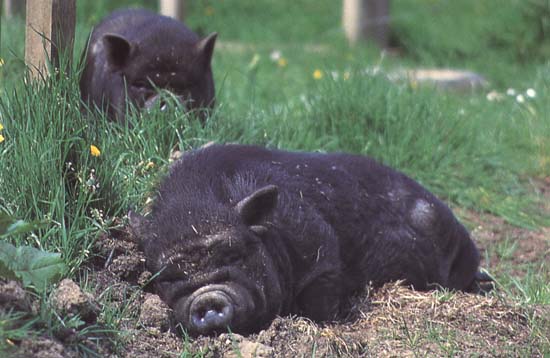
blue sky, even the yellow dandelion in the pig picture) and by choosing
close-ups of animals that look satisfied, as seen best with the smiling cow. I
chose to include a smiling farmer with his cow to show that open range farmers
are more involved with the well-being of their animals, which contrasts with
the industrial, factory-like conditions of the farming shown later. By showing
that animals are happier on the open range, which will greatly contrast with
the harsh, cramped conditions shown later in the video, I am giving a reason as
to why factory farming is cruel (taking away their happiness).
The use of the phrase “but then” signifies a shift in
mood, and transitions into the contrasting evidence. I used a picture of
well-known fast food chains with a picture of a bar-coded cow on top of it (the
logos) to signify the fact that meat was seen only as a product of economic
value, introducing the idea that animals are not treated humanely when they are
raised and produced to be sold. I then introduce the horrible, cramped, unsanitary
conditions of factory farming with images of chickens, pigs, and cattle—the
three types of meat that factory farming has the biggest impact on. The
organization of each type of meat goes as follows: conditions, death,
commonplace food that contains this type of meat (I used fried chicken,
hotdogs, and a hamburger). This shows how the meat is raised and how it gets
into the hands of the consumer. The presentation of death is used to show the
unsanitary and cruel conditions the animals are exposed to on the farms, it is
not meant to be taken literally, however a viewer may. The misconception, for
example, of the chicken in a pile of feathers and manure ending up being the
fried chicken one eats for dinner will work as a disgusting turn off for the viewer.
Or, with the picture of the hamburger, the last food item and the most personal
looking picture, it seems as if the viewer is going to take a bite of that
hamburger, which would be very unappealing to a consumer who now knows (or
thinks he knows) the story behind the hamburger. All pictures of the animals
and their conditions are dark and dreary; the faces of the animals (especially
the cow eating with the other cows) are almost twisted into a frown.
I chose
to include the video of the cow being pushed around by a forklift because it
reinforces everything I am presenting in this visual. It shows that the cow is
in a penned in area with many other cattle, it shows the dirty conditions, and
it, most importantly, flat out shows how terribly animals are treated with the
chains on the animal’s ankles and the treatment from the forklift. This
complete abuse adds shock to the video because it is making the whole situation
real—this actually happens, and now the audience has witnessed it. It draws on
their emotions, making them feel bad for the innocent cow that is being pushed
around. I continue to build on this pity emotion by showing a picture of a
dead, bloody, and dirty cow, which is worse than just a dead cow because it
shows that the cow did not live a comfortable life (also the sad-looking calf
in the background adds to the intense emotion). By showing an advertisement
that asks “how much cruelty can you swallow?” and lists off how the animals are
treated I bring the issue into the viewer’s hands, it is up to him to decide if this is acceptable.
This is supported by a “spotlighted” button saying “you are what you eat.”
Although I end without proposing what to do or what is right or wrong the
readers will most likely be feeling sorrow for the mistreated, miserable
animals (as compared to the happy ones) that they eat every day and maybe will
even take a stand in the movement against factory farming.
Finally,
the overall style of the video is simple. I made many different versions with
these same pictures and this had the most impact because of its style. At no
point are there are other pictures cued up on the side that the viewer can see,
forcing the viewer to concentrate on the image in front of him; he has a better
opportunity to take it all in, and start to develop his opinions on the topic.
Also, this simplicity and focus on the images leads to a build-up of the
emotion of sadness (for the animals) and guilt in the viewer because there is
nothing else for him to avert to, or be distracted by if a sad pictures make
him feel guilty, which is my main goal with this argument!
Part 3: Musical Impact
Like the
organizational style of this visual, I knew that I wanted to have very simple
music. The focus of this project is on the animals and their conditions, a very
serious topic, so I didn’t want any lyrics or dramatic clashing of cymbals or
tooting of horns to distract the reader. Had I chosen a lighter topic such as
current science and its positive success I would’ve chosen a more upbeat,
complicated song to add positive emotional charge and to reflect complexity of
science. The song I chose—Nannou 2 by Aphex Twin—is made up of simple minor
piano chords, each broken up by pauses. I chose an instrumental song because it
does not state my opinion through its lyrics, but it does portray my opinion
through the emotions it provokes in the reader. Its simplicity makes it easy to
twist the mood of the song. At first, with the open range pictures it seems
melancholy, and calm, but it takes on a much more reflective, sad tone when its
minor key, a key that naturally evokes sadness, pictures of horrible treatment.
At some points during the video the notes rise and then fall, ending the phrase
with a low chord. These slow runs add movement in the video, keeping the reader
tuned in, and they also keep the reader attentive because sometimes it seems as
if the end of a phrase will be the end of the video, but then more atrocious
pictures come, putting the emotional endurance of the viewer to test.
Photos used:
Photos used:




Video: "Cheap Meat" (Humane Society) Farming/767131873001/Cheap-Meat/
Music: Aphex Twin (Nanou 2)
Saturday, December 24, 2011
Pinterest Does It Again #image

I know I've already posted these posters but this one seemed like it was made for this class.
Subscribe to:
Posts (Atom)